
-


Wedgwood Black Jasperware Plate
£950.00 -


Sevres Style Porcelain Teapot
£1,250.00 -


KPM Porcelain Plaque La Gondole d’Amour After Ignace Spiridon
£2,200.00 -


French Pair of Sèvres Style Ormolu Mounted Serving Dishes
£2,500.00 -


Sevres Porcelain Table Clock
£2,250.00 -


Meissen Reticulated Porcelain Plate
£2,500.00 -


Vienna Porcelain Cup and Saucer
£1,850.00 -

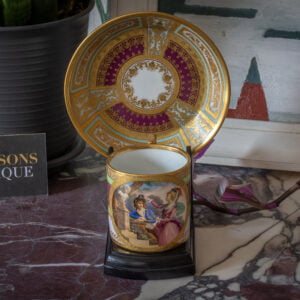
Vienna Porcelain Cup and Saucer
£1,650.00
Antique European Ceramics
Antique European ceramics are among the finest examples of craftsmanship and artistic expression from the continent’s rich cultural heritage. These exquisite objects, which serve both practical and decorative purposes, highlight the remarkable skill and innovation of European ceramic manufacturers from the late 18th to the 19th centuries.
From the delicate porcelain of Sèvres to the bold designs of Meissen, the tradition of European ceramics encompasses a diverse range of styles, techniques, and historical significance that continues to captivate collectors and enthusiasts around the world.
Historical Context and Development
The history of European porcelain began centuries after it was first produced in China during the Tang Dynasty (618-907). Marco Polo introduced the first example of porcelain to Europe upon his return to Italy in 1295—a small white vase that now resides in the San Marco Treasury. The term “porcelain” is believed to derive from its resemblance to small white sea shells, which were reminiscent of little pigs or “porcella,” once used as currency in the Far East.
By the early 15th century, porcelain was regarded as a precious luxury material—often referred to as “white gold”—and was highly coveted by European nobility. However, the secrets of its production remained elusive until a significant breakthrough in Florence under Francesco de’ Medici (1575-1597), when a soft-paste porcelain known as “Medici Porcelain” was developed.
A pivotal moment in European porcelain production occurred in 1708 when physicist Johann Friedrich Böttger and alchemist Ehrenfried Walther von Tschirnhaus succeeded in creating hard-paste porcelain. This breakthrough prompted Augustus II, King of Poland, to establish the first European hard-paste porcelain factory at Meissen in 1710. For nearly a decade, the formula remained a closely guarded secret within the walls of Albrechtsburg Castle.
Once the production techniques and kiln technology became more widely understood in the mid-18th century, porcelain factories began to emerge across Europe. This development coincided with changing social tastes and a growing desire for exotic consumables such as tea, coffee, and chocolate, which created a demand for suitable vessels made from this new and delicate material.
Major European Manufacturers
Meissen (Germany)
Established in 1710, Meissen holds the distinction of being the first European manufacturer of hard-paste porcelain. Under the patronage of Augustus II of Poland, the factory pioneered techniques that would influence all subsequent European porcelain production. Their crossed swords mark, introduced in 1723, became one of the most recognisable and widely imitated pottery marks in history.
Meissen’s early productions included hand-painted tables, but the factory is perhaps best known for its figurines, which were first issued around 1735. The most accomplished were those by Keandler (active 1731-1765). These figurines represented an entirely new art form, taking inspiration from contemporary painting, gallant subjects, and characters from the Commedia dell’Arte.
Sèvres (France)
The Sèvres factory, originally established at Vincennes before being transferred to Sèvres under the patronage of Madame de Pompadour, became synonymous with luxury and refinement. The factory benefited enormously from royal patronage, particularly under Louis XV and later Louis XVI.
Sèvres is renowned for its distinctive ground colours, particularly the famous ‘bleu de Sèvres’ and ‘rose Pompadour’, as well as its elaborate gilding and exquisitely painted scenes. The factory’s interlaced ‘L’ mark (often containing a date letter) became as widely imitated as Meissen’s crossed swords.
Vienna (Austria)
The Vienna Porcelain Manufactory (also known as Royal Vienna or Wien Porzellan) was established in 1718 and produced fine hard-paste porcelain until 1864. Vienna porcelain is distinguished by its exceptional painting quality, particularly in miniature scenes, portraits, and classical subjects. The factory’s shield mark, based on the Austrian coat of arms, is well-known to collectors.
KPM (Königliche Porzellan-Manufaktur, Berlin)
Founded in 1763 by Frederick the Great of Prussia, KPM developed a reputation for technical excellence and neoclassical design. The factory specialised in finely painted porcelain plaques, portrait plates, and services with exceptional painting and gilding. KPM’s sceptre mark is highly regarded and continues to be used today.
Distinctive Characteristics and Styles
Soft-Paste vs. Hard-Paste Porcelain
One of the fundamental distinctions in European ceramics is between soft-paste and hard-paste porcelain:
- Soft-paste porcelain: This type was developed first in Europe and has a granular, warmer texture that makes it more absorbent. It typically contains materials such as bone ash, glass, or soapstone and is fired at lower temperatures compared to hard-paste porcelain.
- Hard-paste porcelain: This variety closely resembles Chinese porcelain and is made from kaolin (china clay) and petuntse (china stone). It is fired at extremely high temperatures, resulting in a cold, flinty, glass-like finish. Hard-paste porcelain is more durable but more challenging to decorate.
Decorative Techniques and Styles
European ceramics exhibit a range of decorative techniques:
- Hand-painted decoration: This prestigious and expensive method features finely detailed scenes, figures, landscapes, or floral motifs.
- Transfer printing: Developed in England in the mid-18th century, this technique enabled more consistent and cost-effective decoration.
- Ground colours: These distinctive colored backgrounds, often in blue, pink, green, or yellow, have reserved panels for painted decoration.
- Gilding: This involves applying gold decoration, which can be burnished to achieve different finishes.
- Reticulated work: This technique involves pierced or cut-out designs that create a lace-like effect.
Stylistically, European ceramics followed the prevailing artistic movements of their time:
- Rococo (c.1730-1770): Asymmetrical designs, scrollwork, shell motifs, and pastoral scenes.
- Neoclassical (c.1760-1830): Greek and Roman-inspired forms, geometric patterns, and classical figures.
- Empire/Biedermeier (c.1800-1840): Bold, imposing forms with strong colours and extensive gilding.
- Historicism (c.1840-1900): Revival of earlier styles, often combining elements from different periods.
- Art Nouveau and Art Deco (c.1890-1940): Modern, stylised designs reflecting contemporary artistic movements.
Marks and Authentication
Understanding ceramic marks is essential for collectors of European pottery and porcelain. These marks provide valuable information about an object’s origin, age, and authenticity, though they should be evaluated alongside other factors.
Marks have been applied to ceramics in various ways:
- By incision on soft (unfired) clay
- By impressing a stamp into unfired paste
- By painting or transfer-printing under the glaze (predominantly in blue before 1850)
- By painting, transfer-printing, or stencilling over the glaze
Notable marking practices include:
- Meissen’s crossed swords (1723 onwards)
- Sèvres’ interlaced Ls (often containing date letters)
- Factory marks combined with decorator marks (common in the 19th century)
- Cancellation marks for outmoded, undecorated, or imperfect pieces
It’s important to recognise that many European factories imitate each other’s marks. For example, the Meissen crossed swords were replicated by factories in Ansbach, Berlin, Dresden, and several other locations. Similarly, the Sèvres interlaced Ls mark was frequently copied. Not all imitations were intended to deceive; some, like those made by Samson & Co. of Paris (established in 1845), were deliberate reproductions, often marked with their own distinct variations.
The 1891 McKinley Tariff Act required exported ceramics to include country-of-origin marks (such as “ENGLAND” or “GERMANY”), making this an important dating feature for collectors.
Collectability and Care
Antique European ceramics are highly sought after due to their artistic merit, historical significance, and the prestige associated with renowned manufacturers. Collectors often focus on specific factories, periods, decorative styles, or types of objects.
When evaluating pieces for your collection, consider the following factors:
- Condition: Damage can significantly impact value, so check for chips, cracks, repairs, and restorations.
- Quality of Decoration: Pieces that well-known artists finely paint tend to command higher prices.
- Rarity: Uncommon forms, colours, or decorative styles are generally more desirable.
- Provenance: A documented history of ownership can greatly enhance a piece’s value.
To properly care for antique ceramics:
- Handle the pieces with clean, dry hands, ensuring you support the item rather than lifting it by handles or any protruding elements.
- Display ceramics in stable environments, keeping them away from direct sunlight and heating sources.
- Clean only when necessary, using mild soap and water. Avoid harsh chemicals.
- For valuable or damaged pieces, consider seeking professional conservation services.
European at Jacksons Antique
At Jackson’s Antique, we carefully curate our collection to showcase the finest examples of European ceramic craftsmanship. We focus on pieces that are both aesthetically pleasing and collectable due to their exceptional decoration, renowned painters, or distinctive models. Our collection typically spans from the late 18th century through to the late 19th century, covering important periods such as the Belle Époque and Napoleon III. We take pride in offering our clients ceramics that represent the pinnacle of European artistic achievement and historical significance.
